The problem
Family history produces paper faster than anyone can read it. Every archive visit ends with a camera roll and every relative's clear-out adds a box. Every society publishes another volume that is indexed by surname and not by the place or the trade you are chasing. The digital versions are scans that no search can see into, in three languages, with names spelled the way the clerk felt like spelling them that day.
Cloud services would OCR the lot if you uploaded it. Putting a century of a family's private papers on a third party's server was something the two of us wouldn't do, so we built Searchive instead.
How it works in Searchive
- You import the scans and the photos. PDFs from the scanner can be imported by the folder. For photos from an archive visit you select the set and name the document ("Bevolkingsregister Zwolle 1880, deel 3") and it becomes one document with the pages in camera order. JPEG, PNG, TIFF and WebP work. HEIC doesn't yet, so set the phone to "Most Compatible" before the visit.
- You choose the language for each document. A Dutch register, a German church-book transcription, a French letter and an English census extract are each read in their own language. A bilingual document gets two. Old orthography and diacritics are handled. Recognition runs on your own Mac or Windows machine in the background while you do something else.
- You search for the name in all its spellings. Any-word mode takes "Cöln Köln Coeln" or "Meijer Meyer Meier" in one go and returns every page with any of them. All-words mode narrows a name to a place. Exact-phrase mode finds "zoon van" followed by the name you expect. Apostrophes and accents work as you type them: l'église, d'Hondt.
- A click opens the scan or the photo with the match highlighted on it. You read the clerk's entry, the printed line and the letterhead yourself, with no transcription in between that might have the date wrong.
- You keep the finding. Pin the page with a note in your own words ("marriage witness is the brother-in-law from Deventer"). The Pinned screen collects every finding by document. A search's results can be exported as a CSV for your source list. Projects group documents by family line or archive without moving files.
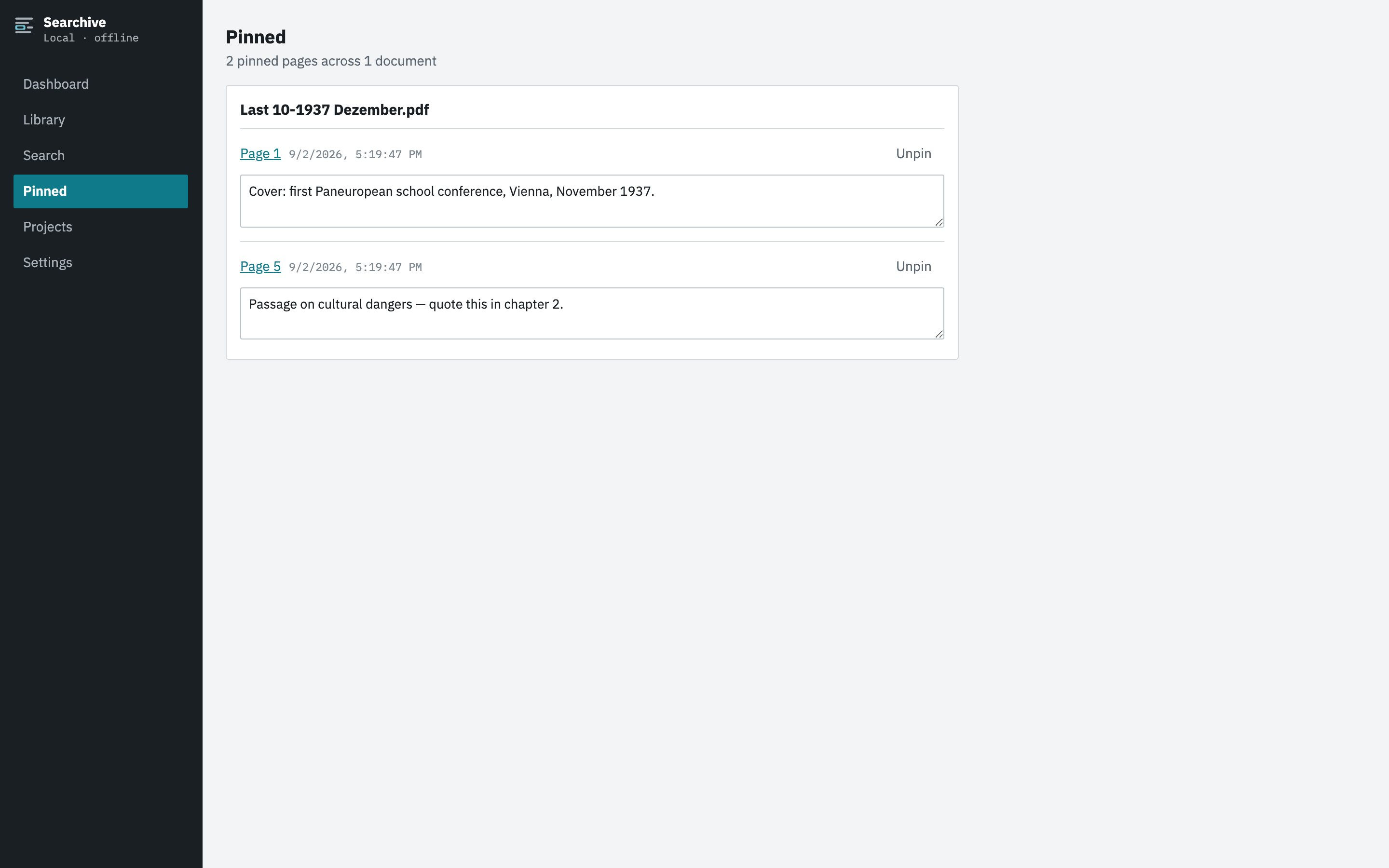
The demo video on the landing page shows the real thing: 1930s journals imported, read, searched and a finding pinned with a note.
Where your family's papers stay
In one folder on your own computer, along with the recognized text and the index. Nothing is uploaded, no account is needed and there are no analytics. It works in the archive basement with no signal. The free tier never contacts anything. You pay once so nothing lapses. Point your backup at the folder and the whole archive is covered.
What it doesn't do
Searchive reads printed and typed text. Most registers from before the late nineteenth century are handwritten, as are letters and diaries. Searchive doesn't read handwriting, so those pages can be imported, viewed and pinned but not searched by content. For handwriting you need handwritten text recognition. Transkribus is the tool for that. Fraktur, the German blackletter typeface, isn't supported yet either. Printed and typed material from roughly the 1850s onwards, in modern typefaces, is where Searchive works well.
Free for one document. A 400-page village yearbook counts as one document: import it, search it, pin it and export from it. No account, no card. Unlimited documents cost €10 once at launch and €39 after.
Join the waitlist